
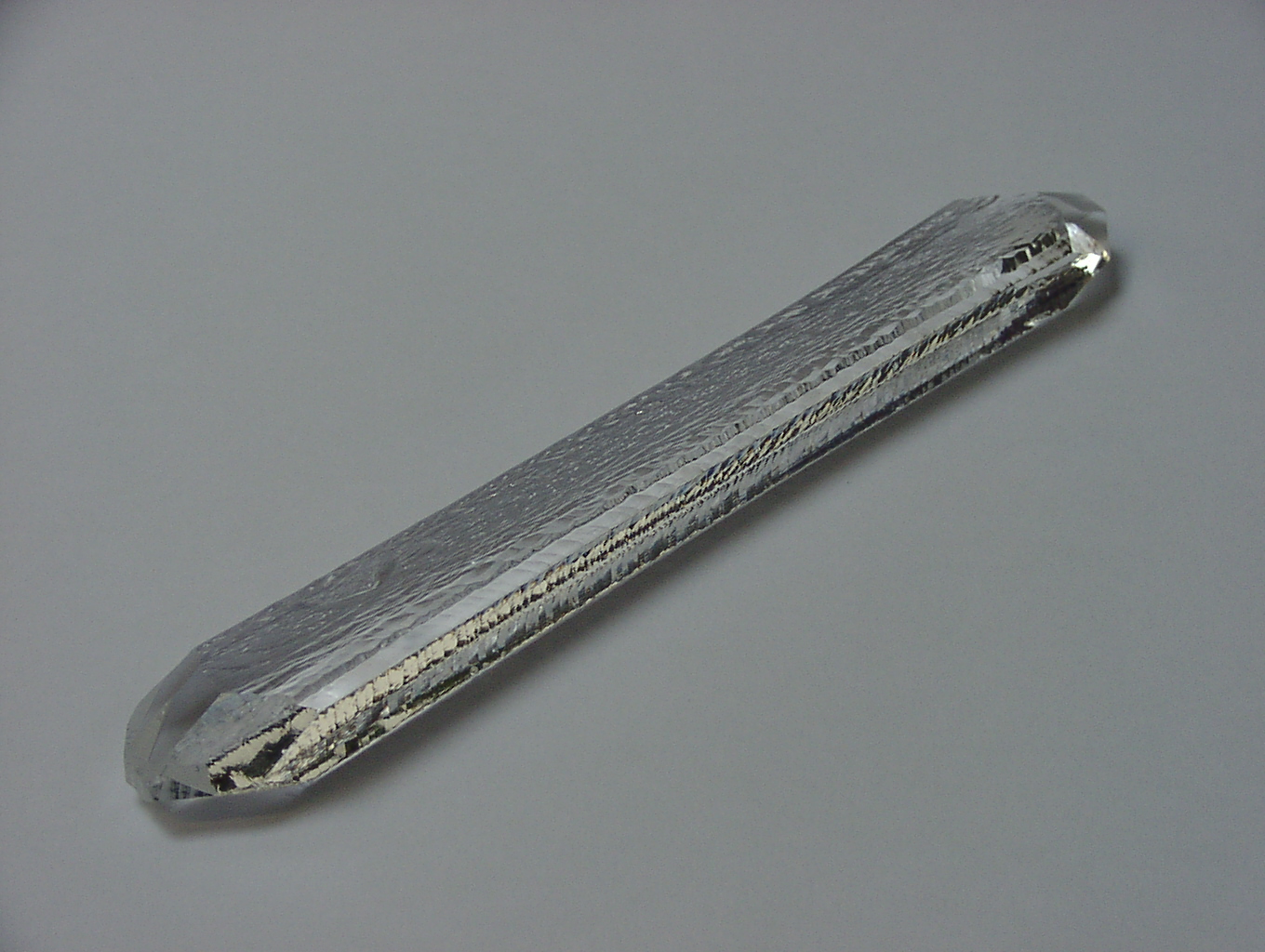
 Why would anyone want to make a synthetic mineral when so much gem quality natural material is available? Technology.
The first synthesized quartz appeared in the mid-nineteenth century. Efforts yielded microscopic crystals. Later on, in the 1890's, macroscopic specimens were reported. Development did not make any notable advances until World War II when the supply of quartz to Germany was cut off.
After the war, researchers and the Army Signal Corps studied work done by the Germans and developed it into a commercially viable process. Synthetic quartz is more stable and uniform than natural material and well suited to applications in electronics. Modern watches, for example, keep accurate time because of a tiny piece of quartz shaped like a tuning fork. Quartz in cell phones and radios filter radio frequencies.
 Quartz is grown in large, canon shaped autoclaves. These essentially work like pressure cookers. A nutrient solution consisting of crushed quartz, alkaline water and sodium hydroxide is placed in the autoclave. Then the seed plates are lowered into the chamber. Then, apply the heat and pressure. Read this for the in-depth explanation of how this works. Crystals are ready in three to four weeks.
Colors may be induced by "doping" the nutrient solution with various elements. Iron produces green or yellow which can be irradiated to make purple. Cobalt produces blue.
 In addition to technological applications, synthetic quartz can be found in jewelry. The growth process has advanced to the point where only well equipped gem labs can separate synthetic from natural quartz gems. However, blue and strongly colored greens are always synthetic.
Sources
Colored Stones course material from GIA
http://www.vogelcrystals.net/Hydrothermal.htm
http://www.roditi.com/SingleCrystal/Quartz/Hydrothermal_Growth.html
http://sawyerllc.com/newstart.htm
http://www.qiaj.jp/pages/frame20/page01-e.html
Featuring artisan handmade creations by the Etsy starving artists jewelry team. SATeam members create handcrafted jewelry and beads. More information about our team and its current Etsy shop owner members can be found at SATEAM.etsy.com.


